Galton Board Normal Distribution Model
INTRODUCTION TO GALTON BOARD

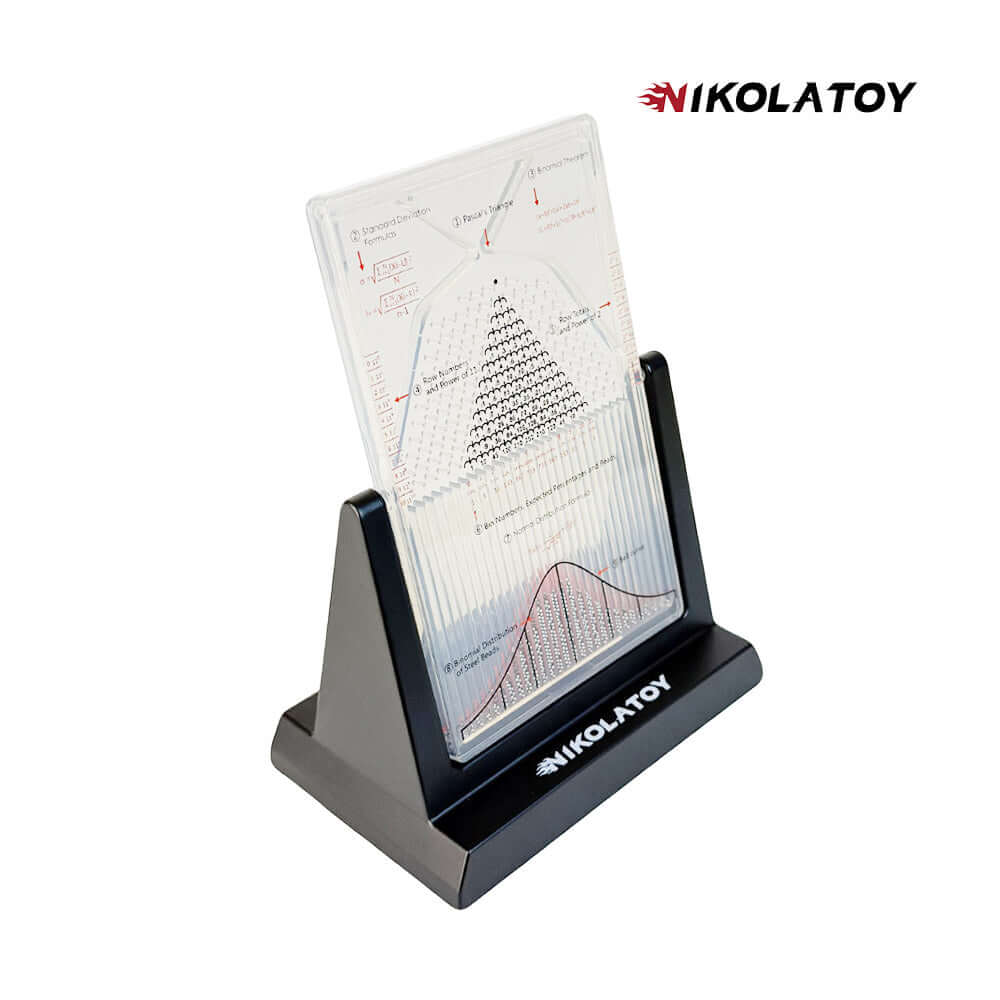
Place a small round glass ball with a diameter slightly smaller than the distance between two nails at the entrance. As the ball descends, it rolls down to the left or right with a probability of 1/2 after hitting the nails, and then touches the next layer of nails. Continue like this until you roll into a grid on the bottom plate. Continuously dropping numerous small balls of the same size from the entrance, as long as the number of balls is quite large, they will be stacked on the bottom plate to form an approximately normal density function graph (i.e., a symmetrical ancient bell shape with a high middle and low ends), where n is the number of layers of nails.
This is a model designed by British biostatistician Galton to study random phenomena
INTRODUCTION TO GALTON BOARD
Place a small round glass ball with a diameter slightly smaller than the distance between two nails at the entrance. As the ball descends, it rolls down to the left or right with a probability of 1/2 after hitting the nails, and then touches the next layer of nails. Continue like this until you roll into a grid on the bottom plate. Continuously dropping numerous small balls of the same size from the entrance, as long as the number of balls is quite large, they will be stacked on the bottom plate to form an approximately normal density function graph (i.e., a symmetrical ancient bell shape with a high middle and low ends), where n is the number of layers of nails.
This is a model designed by British biostatistician Galton to study random phenomena
Original: $9,700.00
-70%$9,700.00
$2,910.00Description
INTRODUCTION TO GALTON BOARD
Place a small round glass ball with a diameter slightly smaller than the distance between two nails at the entrance. As the ball descends, it rolls down to the left or right with a probability of 1/2 after hitting the nails, and then touches the next layer of nails. Continue like this until you roll into a grid on the bottom plate. Continuously dropping numerous small balls of the same size from the entrance, as long as the number of balls is quite large, they will be stacked on the bottom plate to form an approximately normal density function graph (i.e., a symmetrical ancient bell shape with a high middle and low ends), where n is the number of layers of nails.
This is a model designed by British biostatistician Galton to study random phenomena